
The IELTS Speaking Test
The IELTS Speaking test is one of the most challenging parts of the IELTS exam for many candidates. If you feel nervous about speaking English in front of an examiner, you are certainly not alone.
The good news is that you can prepare effectively once you understand how the test works and what the examiner expects from you.
This guide will help you understand the IELTS Speaking test, avoid common mistakes, and develop the skills you need to achieve your target band score.
The goal is to help you enter the exam room feeling prepared, confident, and ready to demonstrate your English-speaking ability.

Tip: Speak naturally, as if you were having a conversation with a friend.
Here is what we will cover in this guide:
- Format of the Speaking test – Parts 1, 2 & 3
- The main reason for low scores
- How to avoid this common mistake
- The 4 key skills you’ll be assessed on
You will also find links to IELTS-style speaking questions to help you practise and improve your performance.
At the end of this guide, you can explore additional resources covering specific aspects of the IELTS Speaking test.
1# Format of the IELTS Speaking Test
The IELTS Speaking test follows the same format for both IELTS Academic and IELTS General Training.
Your Speaking test may take place on the same day as your Listening, Reading, and Writing tests, or on a different day, depending on the test centre’s arrangements. Speaking tests are recorded for assessment and quality assurance purposes.
The test lasts approximately 11–14 minutes and consists of three parts. Each part assesses your ability to communicate in English in a different situation.
IELTS Speaking Test – Part 1
Time: 4–5 minutes
In Part 1, the examiner asks questions about you, your life, and familiar everyday topics.
Common subjects include:
- Your work or studies
- Your home
- Your family
- Your hometown
- Your likes and dislikes
These questions are generally familiar because they relate to your own experiences, interests, and daily life.
Try to relax and answer each question naturally. You do not need to give complicated responses or impress the examiner with unusual vocabulary.
Aim to answer the question directly and add a relevant detail or explanation where appropriate. This will help you demonstrate your ability to communicate clearly while keeping your answers concise.
Think of Part 1 as an opportunity to settle into the conversation and build confidence for the rest of the test.
IELTS Speaking Test – Part 2
Time: 3–4 minutes
In Part 2, the examiner gives you a cue card containing a topic and several bullet points to help you organise your talk.
You will have one minute to prepare and make notes. After that, you will be asked to speak about the topic for up to two minutes. The examiner may then ask one or two brief questions related to your talk.
The topics can cover a wide range of subjects, but many relate to your personal experiences, memories, and opinions. For example, you might be asked to describe:
- Something about yourself
- Something that happened to you
- An experience you have had
Here is an example of an IELTS Speaking Part 2 cue card.
Describe a party you have been to.
You should say:
- Whose party it was
- Where the party was held
- Who was there
And explain what you did at the party.
The first sentence introduces the main topic. In this case, you need to describe a party you attended.
The bullet points suggest details you could include, but you do not have to follow them rigidly. You can add relevant information, personal experiences, and descriptions to develop a complete and natural talk.
The key is to organise your ideas clearly and keep your response focused on the main topic.
For a more detailed explanation of cue cards, preparation techniques, and sample answers, explore our dedicated guide:
IELTS Speaking Part 2
IELTS Speaking Test – Part 3
Time: 4–5 minutes
Part 3 involves a discussion with the examiner about ideas and issues connected to the topic from Part 2.
Unlike Part 1, which focuses mainly on familiar personal topics, Part 3 encourages you to discuss broader issues, explain your opinions, compare ideas, and consider different perspectives.
This section is more interactive. You will need to develop your answers, support your opinions with reasons or examples, and discuss more general questions.
For example, if your Part 2 topic was about a party, the examiner might ask:
- When do people usually have parties in your country?
- What makes a good party?
- How important is it to celebrate special occasions with other people?
- Why do some people dislike attending parties?
- How do people in your country usually celebrate the New Year?
- Do you think festivals and celebrations have become too commercialised or lost their original meaning?

Party and celebration topics can lead to a wide range of IELTS Speaking Part 3 questions.
To perform well in Part 3, avoid giving only short answers. Explain your reasoning, provide relevant examples, and show that you can discuss an issue from different perspectives.
2# Why People Get a Low Score & How to Avoid This Big Mistake
One common reason candidates achieve a lower IELTS Speaking score than expected is that they misunderstand what the examiner is assessing.
Knowing the test format is important, but understanding the assessment criteria is equally essential. Once you know what the examiner is looking for, you can prepare more effectively and avoid wasting time on the wrong strategies.
Many candidates focus too heavily on preparing impressive answers or learning complicated vocabulary without understanding how to use these skills naturally during the test.
Let’s clarify what the IELTS Speaking test is actually designed to assess.
Here are some important points to remember:
- It is not a test of your general knowledge or intelligence.
- You do not need to be an expert on the topics you discuss.
- Your opinions are not judged according to whether the examiner agrees with you.
- Your ability to communicate in English is what matters most.
The examiner wants to understand your ideas and evaluate how effectively you express them in English.
You are not expected to have extensive knowledge of every topic. You are taking an English language test, not an academic examination on the subjects mentioned in your questions.
If you receive an unfamiliar question, you can use your general knowledge, personal experiences, observations, or imagination to develop a relevant response. What matters is how clearly and effectively you communicate your ideas.
What will you actually be assessed on?
IELTS examiners use official assessment criteria to evaluate your speaking performance across four areas.
You can consult the official IELTS Speaking band descriptors to understand the requirements for different band scores.
The test assesses your ability to:
- Communicate opinions and information about everyday topics and common experiences.
- Speak at length about a given topic using appropriate language.
- Organise and connect ideas coherently.
- Express and justify your opinions.
- Analyse, discuss, and speculate about different issues.
These abilities are assessed through four key criteria, which we will explore in the next section.
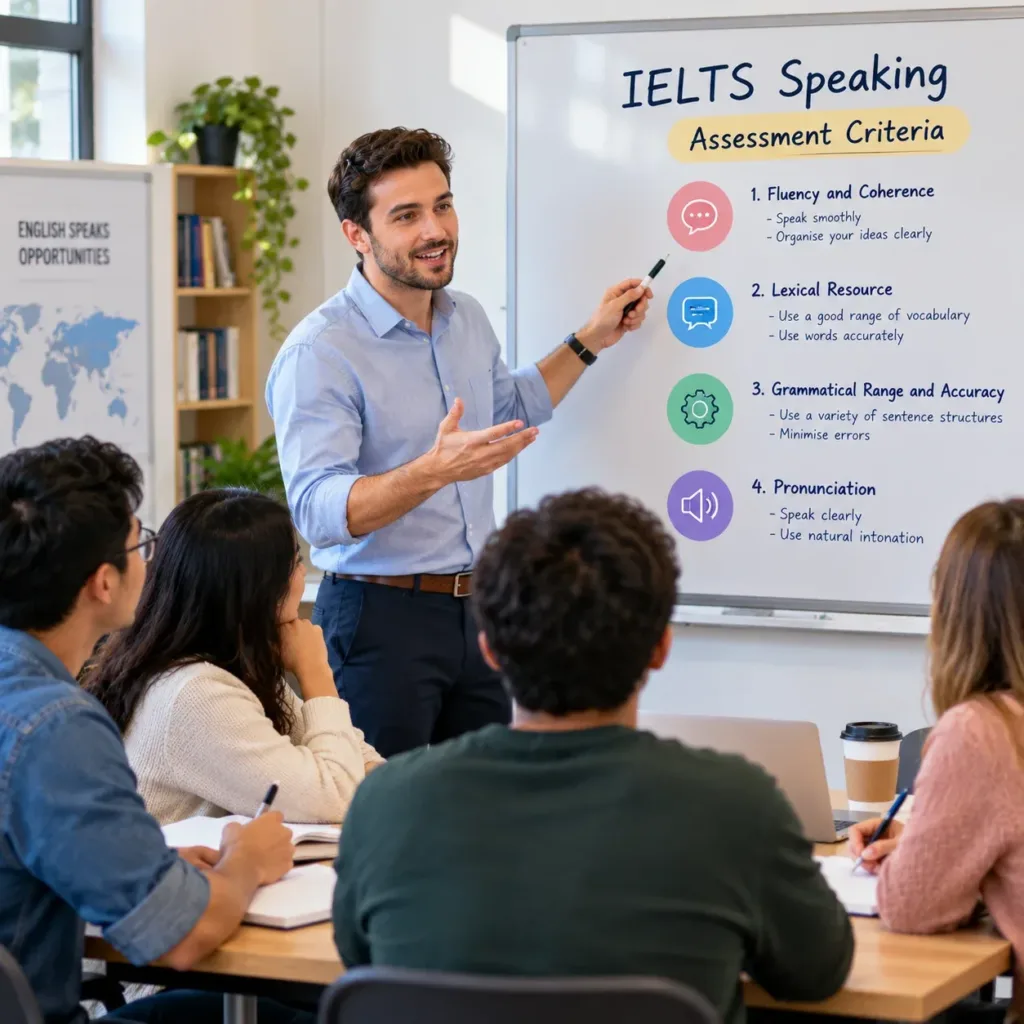
You do not need to be an expert on a topic. Focus on communicating your ideas clearly and naturally.
3# The 4 Key Skills You’ll Be Assessed On
So, what exactly does the examiner evaluate during your IELTS Speaking test?
Your performance is assessed using four criteria:
- Fluency and Coherence
- Vocabulary
- Grammar
- Pronunciation
Each criterion contributes 25% to your overall Speaking band score. This means that you should develop all four skills rather than concentrating exclusively on vocabulary or grammar.
Fluency & Coherence
Fluency refers to your ability to speak at a natural pace without excessive hesitation, unnecessary repetition, or frequent interruptions.
Coherence refers to how clearly you organise and connect your ideas so that your response is logical and easy to follow.
Both are essential for effective communication.
You do not need to speak extremely quickly to demonstrate fluency. Instead, focus on maintaining a natural flow, developing your answers, and connecting your ideas appropriately.
Using simple linking expressions and organising your response logically can help you improve coherence.
Vocabulary
To achieve a strong score, you need to demonstrate a range of vocabulary and use words and expressions accurately.
A common mistake is assuming that using as many advanced or complicated words as possible will automatically lead to a higher score.
In reality, forcing unfamiliar vocabulary into your answers can make your speech sound unnatural or cause you to use words incorrectly. It can also make your meaning difficult to understand.
The examiner wants to hear appropriate vocabulary that communicates your ideas clearly and precisely.
You do not need to sound like a university professor giving a lecture. Aim to speak naturally while choosing words and expressions that suit the topic and context.
Expanding your vocabulary through topic-based practice, useful expressions, and sample answers can help you develop this skill.
Start exploring our dedicated resource:
IELTS Vocabulary
Grammar
Grammar is another important part of your IELTS Speaking score. You need to demonstrate that you can use a range of grammatical structures accurately and appropriately.
Keep these three points in mind:
- Avoid making your answers unnecessarily complicated.
- Choose grammatical structures that suit the question.
- Practise using different tenses and sentence patterns accurately.
You should understand how to use different tenses, sentence structures, and grammatical forms to express your ideas.
However, using complicated grammar in every answer is unnecessary. For example, if a question asks about your daily routine, you do not need to force several different tenses into your response simply to demonstrate your knowledge.
Instead, select the structures that naturally fit the meaning you want to communicate.
A balanced combination of grammatical variety and accuracy will help you express your ideas more effectively.
Pronunciation
Pronunciation is essential because the examiner needs to understand what you are saying.
You do not need to imitate a British, American, or Australian accent. Your priority should be speaking clearly and making your message easy to understand.
Five important features contribute to effective pronunciation:
- Individual sounds
- Word stress
- Sentence stress
- Connected speech
- Intonation
Individual sounds help you pronounce words clearly. Word stress helps listeners recognise syllables within words, while sentence stress highlights important information.
Connected speech helps your words flow naturally, and intonation allows you to communicate meaning, emphasis, and attitude through changes in your voice.
Pronunciation works alongside vocabulary and grammar to make your message understandable. Developing these features will help you communicate more confidently and demonstrate your English-speaking ability.
Now that you understand what the examiner assesses, you can focus your preparation on the skills that directly contribute to your Speaking score.
IELTS-Style Practice Speaking Questions
One of the most effective ways to prepare for your IELTS Speaking test is to practise answering a wide range of IELTS-style questions.
Regular practice helps you become familiar with common topics, organise your thoughts more quickly, and express your ideas with greater confidence.
Explore the topic-based vocabulary pages on our website to find practice questions, useful expressions, and sample answers.
Try answering questions aloud rather than simply reading the examples. You can also record yourself and review your fluency, vocabulary, grammar, and pronunciation.
With consistent practice and a clear understanding of the assessment criteria, you can build the skills needed to approach your IELTS Speaking test with confidence.

IELTS Speaking Tips: Discover 9 top tips to increase your chances of achieving a high score.
IELTS Speaking Topics: Explore the 40 most common subject areas covered in the IELTS Speaking Test.
IELTS Speaking Practice Questions: Download 30 complete mock tests featuring 30 practice cards across 30 topics, with 330 questions in total.
Find More Help With Your IELTS Speaking Test With These Lessons
Lesson 1: IELTS Speaking Part 1
Learn 7 simple methods for developing your Part 1 answers, with plenty of sample questions and answers. Explore the most common topics and discover what happens during the pre-test introduction.
Lesson 2: IELTS Speaking Part 2
Discover 5 common reasons why candidates receive low scores in Part 2 of the IELTS Speaking Test and learn how to avoid these mistakes. Understand the test format and become familiar with the cue card.
Lesson 3: Part 2 Planning Strategy & Speaking Sample 1
Learn how to use the question-prompt method to plan your Part 2 talk and make the most of your one-minute preparation time. Includes detailed planning notes and a sample speaking answer.
Lesson 4: Part 2 Planning Strategy & Speaking Sample 2
Follow a step-by-step guide to using the brainstorming method to plan your talk quickly and easily. Learn how to develop your ideas into a two-minute response, with full planning notes and a sample speaking answer.
Lesson 5: Part 2 Planning Strategy & Speaking Sample 3
Discover how to use the five senses to plan your Part 2 talk effectively. Learn how this technique works and why storytelling is important, with detailed planning notes and a sample speaking answer.
Lesson 6: How To Begin Your Part 2 Talk
Explore 7 simple ways to start your Part 2 talk. Learn quick and effective techniques for improving your opening sentences, with plenty of examples to help you get started confidently.
Lesson 7: IELTS Speaking Part 3
Learn about 6 common question types and how to answer them effectively. Discover key mistakes to avoid and practise with sample questions and answers to help you impress the examiner and achieve your target score.
Lesson 8: IELTS Speaking Practice
Improve your speaking skills significantly by learning how to think in English. This is one of the most valuable techniques you can develop to speak more naturally and confidently during the IELTS Speaking Test.